Manga and Webtoon Slang Glossary: BL, GL, Josei, Seinen Explained

By Alex Corner
 Nov 10, 2026
 8 min
What’s good, everyone? Alex here.
If you’ve ever landed on a manga or webtoon page and wondered what BL, GL, josei, or seinen actually mean, you’re not alone. Those labels show up everywhere, and once you know them, the whole catalogue makes a lot more sense.
I’ve put together a guide to the most important terms and their definitions, so you’ll know exactly what they mean the next time you’re browsing.
Let’s get into it.
Searching for manga and webtoon terms usually means one thing: you’ve seen labels like BL, GL, josei, or seinen and want a straight answer. This manga glossary covers the slang and category names that show up everywhere — from store shelves to platform filters — so you can browse without guessing.
Recently, the terms BL and GL have become increasingly popular across the internet. But what do they actually mean, and how can you understand them? With this guide, webtoon terms and manga slang will quickly start to make sense. And if you’re ready to explore these genres yourself, sign up on HoneyToon and discover stories that match your interests.
25 Manga And Webtoon Terms At A Glance
| Term | Simple Meaning |
|---|---|
| BL | Boys’ Love — romance between male characters |
| GL | Girls’ Love — romance between female characters |
| Shonen | Manga aimed at teen boys; action, friendship, growth |
| Shojo | Manga aimed at teen girls; romance, emotions, relationships |
| Seinen | Manga for adult men; more mature or complex stories |
| Josei | Manga for adult women; realistic romance and life drama |
| Manga | Japanese comics in general |
| Manhwa | Korean comics |
| Manhua | Chinese comics |
| Webtoon | Digital comic designed for vertical scrolling |
| Yaoi | Older term for male/male romance (often more explicit) |
| Yuri | Female/female romance |
| Isekai | Character is transported to another world |
| Harem | One lead with multiple romantic interests |
| Reverse harem | One female lead with multiple male interests |
| Villainess | Stories centered on a “bad” female character, often reborn or rewritten |
| Slice of life | Everyday, low-plot stories about ordinary moments |
| Tsundere | Character who acts cold or harsh but is soft underneath |
| Yandere | Character whose love becomes extreme or obsessive |
| Mangaka | Manga creator / author-artist |
| Doujinshi | Fan-made or self-published comics |
| Episode | Single chapter of a webtoon or series |
| Hiatus | Temporary pause in updates |
| Completed series | Series that has finished its full run |
Genre, Demographic And Format: What Is The Difference?
Demographics describe the intended audience. For example: shonen is aimed at teen boys, shojo at teen girls, seinen at adult men, and josei at adult women. These labels say who the story was primarily made for — not what happens in it. A shonen series can be pure romance; a josei series can include action. The demographic only signals the expected tone, age range, and publishing tradition.
Genres describe the content. Genres include romance, fantasy, drama, action, horror, and comedy. They tell you the type of story, not who it was marketed to. The same genre can appear under any demographic.
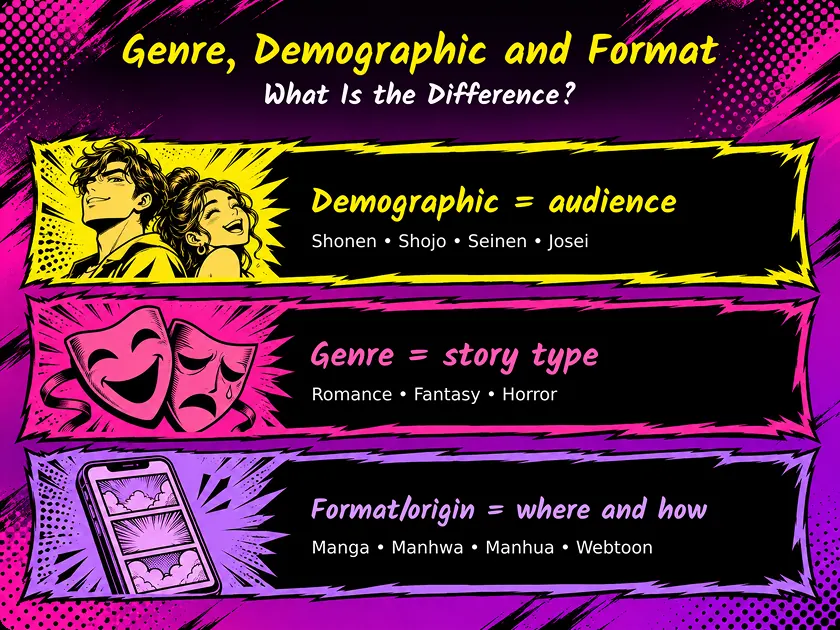
Origin and format describe where the comic comes from or how it is published. Manga is Japanese comics, manhwa is Korean, manhua is Chinese. Webtoon usually means a digital comic built for vertical scrolling on phones — most often Korean, but the word is also used more loosely for the format itself.
Keeping these three layers separate makes browsing much clearer: demographic = audience, genre = story type, format/origin = where and how it is made.
BL And GL Meaning Explained
What Does BL Mean?
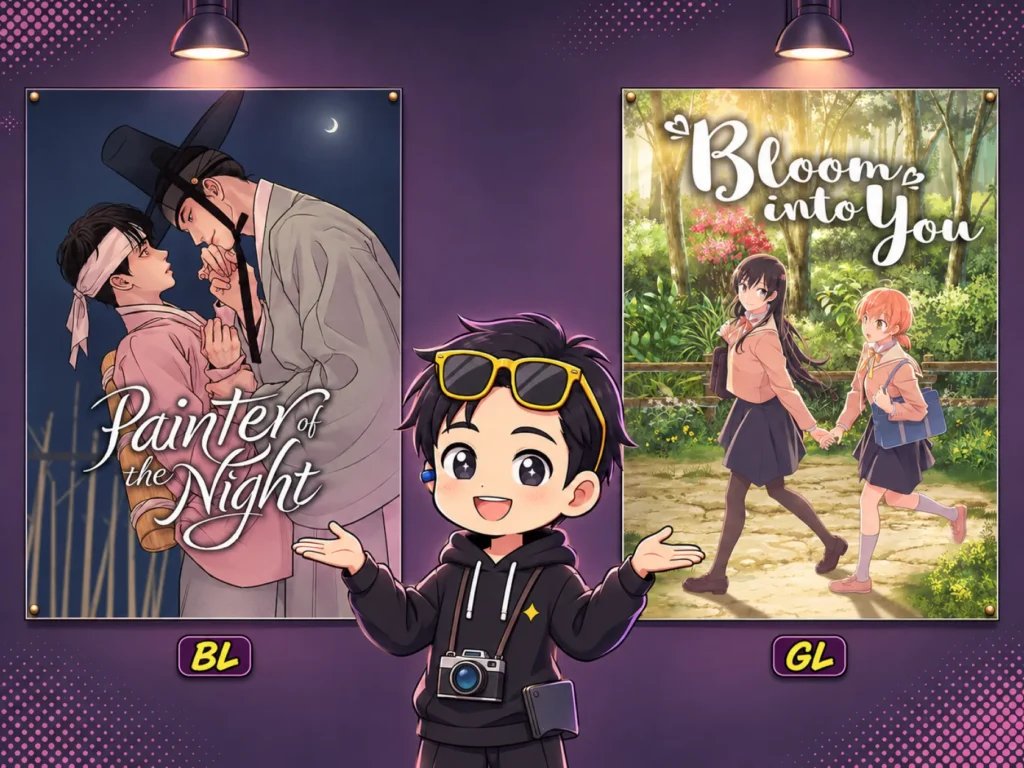
BL stands for Boys’ Love. It is the common industry and platform label for romance between male characters. You will see it on webtoon and manhwa filters, store categories, and recommendation lists. BL covers a wide range — from soft, emotional stories to more explicit ones — and is used as the neutral, modern umbrella term.
BL vs Yaoi
Yaoi is an older term that also describes male/male romance, but it historically pointed toward more explicit or fan-origin content. Today many readers and platforms prefer BL because it is broader and less tied to a single tone. In practice: if a site says BL, it means male/male romance; yaoi often signals a more adult or explicit corner of the same territory.
What Does GL Mean?
GL stands for Girls’ Love. It is the matching label for romance between female characters. Like BL, it appears as a clean category tag across webtoon platforms and covers everything from light romance to mature drama.
GL vs Yuri
Yuri is the older, widely recognized term for female/female romance, especially in Japanese manga. GL is the more recent, platform-friendly equivalent — short, clear, and parallel to BL. Many readers still use yuri in conversation; most digital catalogues and filters now list the category as GL. Content-wise the overlap is large; the difference is mostly labeling and era.
Shonen, Shojo, Seinen and Josei Explained
These four terms are demographics — they describe the intended audience, not the genre.
- Shonen — Aimed at teen boys. Often features action, friendship, rivalry, and personal growth. Tone is energetic and accessible.
- Shojo — Aimed at teen girls. Centers on romance, emotions, and relationships. Visual style and pacing usually emphasize feelings and character bonds.
- Seinen — Aimed at adult men. Stories can be grittier, more complex, or more realistic than shonen. Themes and violence (or quiet character work) are often more mature.
- Josei — Aimed at adult women. Focuses on realistic relationships, work, and life drama. Romance tends to feel less idealized than in shojo
Shonen vs Seinen
| # | Shonen | Seinen |
|---|---|---|
| Audience | Teen boys | Adult men |
| Tone | Energetic, growth-focused | More mature or complex |
| Typical content | Action, friendship, rivalry | Wider range: grit, realism, deeper themes |
| Expectation | Action, friendship, rivalry | Can be darker or more nuanced |
Shojo vs Josei
| # | Shojo | Josei |
|---|---|---|
| Audience | Teen girls | Adult women |
| Tone | Idealized romance, strong emotions | Realistic relationships and life |
| Typical content | First loves, school, drama | Work, marriage, adult complications |
| Expectation | Feelings first | More grounded, less fantasy-romance |
Manga vs Manhwa vs Manhua vs Webtoon
- Manga — Japanese comics. Traditionally printed right-to-left, often black-and-white, and later adapted to digital.
- Manhwa — Korean comics. Can be print or digital; many modern titles are made for vertical scrolling.
- Manhua — Chinese comics. Includes both print traditions and digital series.
- Webtoon — A digital comic format built for vertical scrolling on phones. Full-color episodes, usually released on a schedule. The term started with Korean platforms but is now used more broadly for the format.
Is Every Manhwa a Webtoon?
No. Manhwa is the Korean word for comics in general. Some manhwa are traditional print volumes, others are digital vertical-scroll series. Only the digital, scroll-first ones are webtoons. So every Korean webtoon is a type of manhwa, but not every manhwa is a webtoon.
Is Every Webtoon Korean?
No. The format began in South Korea and is still strongly associated with Korean platforms, but creators and publishers in other countries now produce vertical-scroll comics too. Webtoon mainly describes how the comic is made and read — not the creator’s nationality.
If you want to understand more about the difference between Manga vs Manhwa vs Manhua vs Webtoon – dive into the article Webtoon vs Manhwa vs Manga: What’s the Difference?
Popular Manga and Webtoon Story Terms
- Isekai — A character is transported (or reborn) into another world — fantasy, game-like, or otherwise. The story follows how they adapt and what they change there.
- Reverse isekai — The opposite move: a character from another world arrives in ours. Culture clash and “fish out of water” comedy or drama usually drive the plot.
- Harem — One main character (often male) is surrounded by multiple romantic interests. The tension comes from who gets attention and how the group dynamics shift.
- Reverse harem — One female lead with several male romantic interests. Same structure as a harem, flipped by gender focus.
- Villainess — Stories centered on a female character who was (or is labeled) the villain — often in a reincarnation or “otome game” setup. She may try to avoid her bad ending, rewrite her role, or lean into it.
- Slice of life — Low-plot stories about everyday moments: school, work, friendship, small routines. The pleasure is in mood and character rather than big twists or battles.
Character and Publishing Terms
Character types
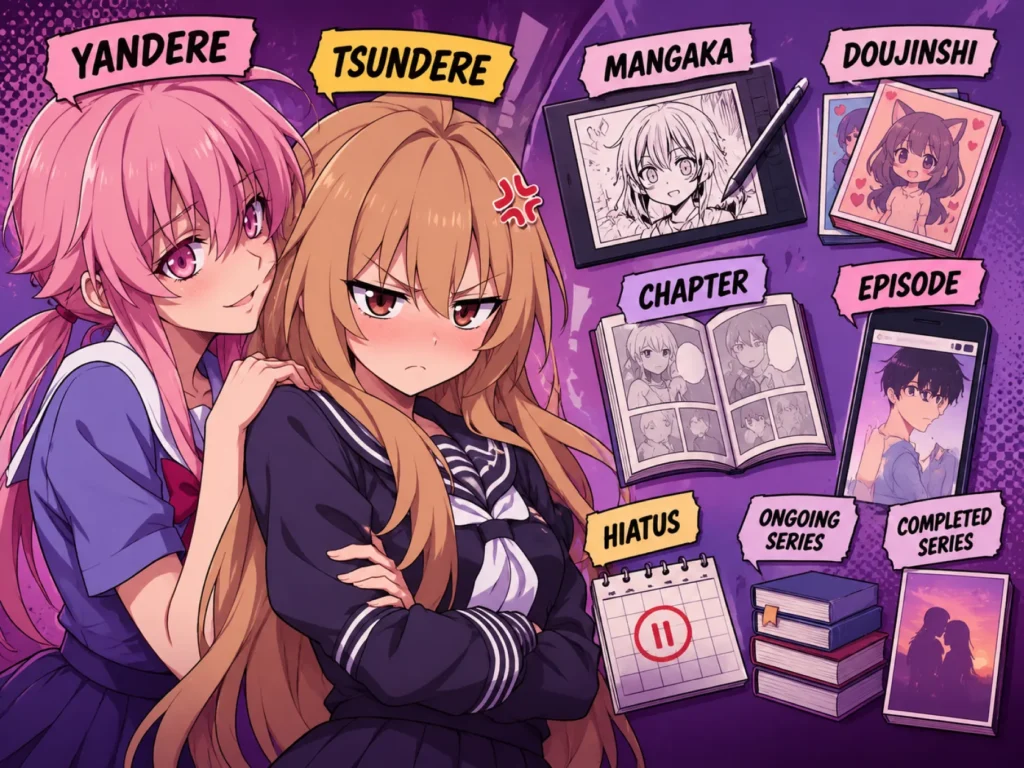
- Tsundere — A character who acts cold, sharp, or dismissive on the surface but is caring or soft underneath. The contrast between the harsh exterior and the hidden warmth is the point.
- Yandere — A character whose love becomes extreme or obsessive. Affection can turn controlling, possessive, or dangerous; the intensity is the defining trait.
Publishing and production
- Mangaka — The creator of a manga — the writer, the artist, or both. In credits you’ll often see one name (or a small team) listed this way.
- Doujinshi — Self-published or fan-made comics. They can be original or based on existing series, and are commonly sold at conventions or online.
- Chapter vs episode — “Chapter” is the usual word for a unit of print manga. “Episode” is the common word for a unit of a webtoon or vertical-scroll series. Same idea: one installment of the story.
- Hiatus — A temporary pause in updates. The series is not finished; new episodes or chapters are simply delayed.
- Ongoing series — Still being published on a schedule (weekly, bi-weekly, etc.). New installments keep coming.
- Completed series — The full story is finished. Every episode or chapter is available, and there is a definite ending — no weekly wait.
How to Use These Labels to Find Your Next Read
Once the terms are clear, use them as filters instead of guessing from covers.
Start with demographic or format if you care about tone: josei and seinen usually feel more adult; webtoon tells you it’s vertical-scroll and full-color. Add a genre or story type next — romance, drama, isekai, villainess, slice of life — so the results match the kind of plot you want. Use BL or GL when you specifically want same-gender romance, and check completed when you prefer a full arc with no weekly wait.
On HoneyToon, you can browse by these categories, open any series with free starter episodes, and decide from the first chapters whether the label delivered what you expected. Definitions get you oriented, and a couple of free episodes tell you if the story is actually for you.
To Sum Up
So, with the help of this glossary, we now understand the main manga and webtoon terms you’re likely to encounter on platforms and store pages. We separated three layers that often get mixed up: demographics (shonen, shojo, seinen, josei), genres and story types (romance, isekai, villainess, slice of life, and the rest), and origin or format (manga, manhwa, manhua, webtoon). BL and GL were defined as the clear labels for male/male and female/female romance, with a short note on how they relate to the older terms yaoi and yuri. Character tags like tsundere and yandere, plus publishing words like episode, hiatus, and completed series, rounded out the practical vocabulary. Once the labels make sense, browsing gets faster and more accurate. Use them to narrow the field, then check free starter episodes on HoneyToon to see whether the story matches what you wanted.


Thanks for your attention, wish you a good reading and see you next time.
Alex