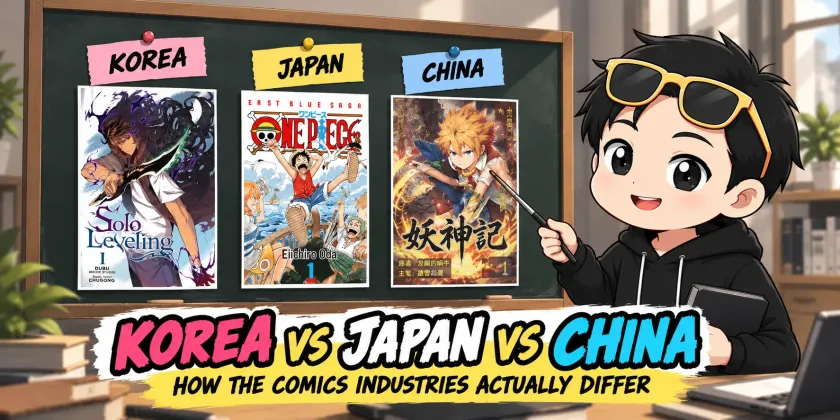
Korea vs Japan vs China — How the Comics Industries Actually Differ

By Alex Corner
 Oct 20, 2026
 8 min
Hey everyone, Alex here!
Manga, manhwa, and manhua get compared all the time — but mostly on the surface. Style, color, reading direction. What’s more interesting is how differently the industries behind them actually work.
Japan, Korea, and China built three separate comics businesses, with different publishers, different payment systems, and different reasons for what ends up on your screen. Once you see that side of it, a lot of the creative differences suddenly make sense.
Let’s break it down.

Manga, manhwa, and manhua often look similar on the surface — sequential art, character-driven stories, global fandoms. Commercially, though, the Korea vs Japan vs China comics industry is three different systems. The real divide is not art style. It is who holds the power, who bears the risk, and who decides what gets made. Sign in to HoneyToon and discover stories worth reading.
Japan runs a publisher-led model built around magazines, editorial committees, and long-form serialization, with anime as the main export engine. South Korea built a platform-led digital industry where audience data, freemium pricing, and IP adaptation pipelines drive both creator income and global growth. China operates a large domestic platform market shaped by regulation as well as commercial incentives, with strong internal scale but quieter international reach.
This article breaks down how each industry actually works: how series get published, how creators get paid, why certain formats and genres dominate, and why Korean webtoons scaled internationally so quickly. Once you see the business structure, the creative differences stop looking accidental.
The Short Answer
Here’s the simplest way to understand the difference:
- Japan — A print-first industry built around major publishers, magazine serialization, and long editorial relationships. Creators often work under a mangaka-led model with assistants.
- South Korea — A digital-first industry shaped by webtoon platforms. Vertical-scroll format, full color, and platform-driven release schedules dominate the market.
- China — A large domestic digital market with strong platform control, heavy focus on cultivation and fantasy genres, and its own content and monetization rules.
The takeaway:
The difference isn’t mainly the art. It’s who decides what gets made — and how creators get paid for it.
Japan — The Publisher-Led Industry
The Japanese manga industry business model is still built around major publishers and magazine serialization. Power sits with the publisher, not the platform.
How Work Gets Published
Most professional manga still begins with an editor. Creators submit one-shots or compete in publisher awards. If selected, they work with an assigned editor to develop the concept, refine the storyboard (name), and prepare for serialization. Once greenlit by an editorial committee, the series runs in a weekly or monthly magazine before being collected into tankōbon volumes. The editor remains deeply involved throughout — shaping pacing, character decisions, and commercial direction.
Who Holds the Power
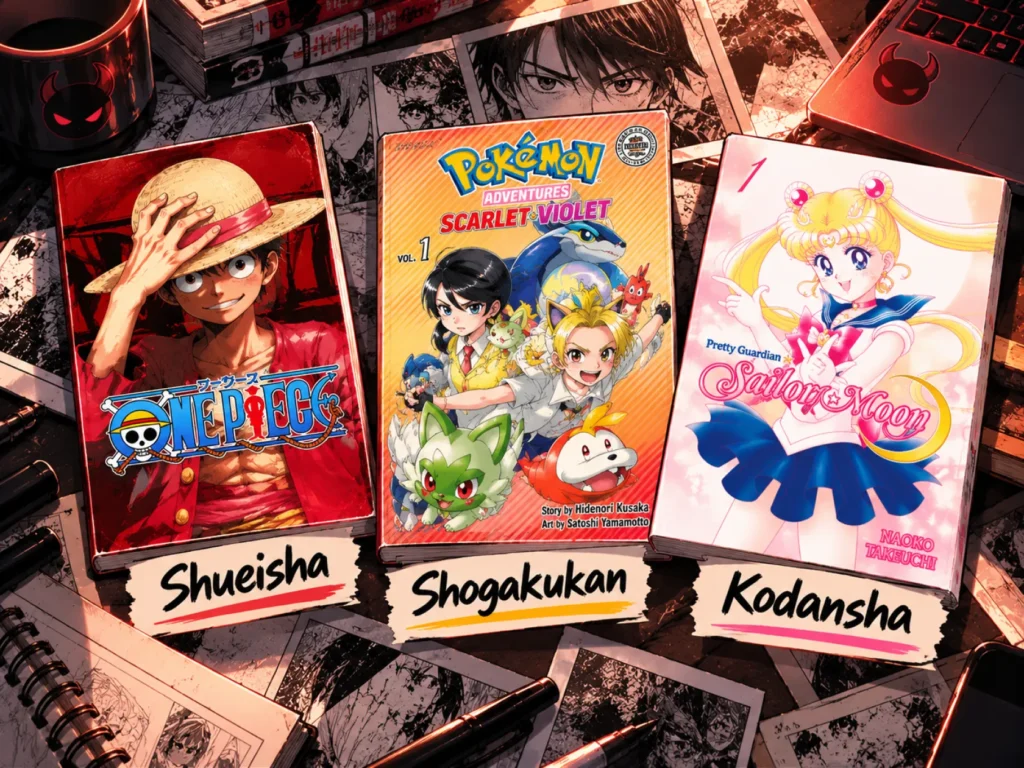
In Japan, publishers such as Shueisha, Kodansha, and Shogakukan control the gate. Editorial committees decide what gets serialized and what gets cancelled.
Reader surveys influence rankings, but the final call stays inside the publisher. Creators often work with assistants, and the financial risk of print production sits primarily with the publishing house.
Why the Model Looks the Way It Does
Print costs, magazine real estate, and long editorial relationships created a system where quality control and brand consistency matter more than rapid iteration. The result is slower entry for new creators, but also long-running franchises that can last decades when they succeed. High editorial control is not a side effect — it is the core of the system. That discipline helps explain Japan’s deep catalogue and the craft consistency readers still associate with long-running manga franchises.
How Japan Exports
Anime adaptation is the primary export engine. A successful manga becomes the foundation for animation, merchandising, games, and global licensing. The manga itself is often the first step in a much larger media mix.
Where It’s Heading
Digital platforms and apps are growing, and some titles now launch digitally first. The core structure, however, remains publisher-led. Editorial gatekeeping and the anime pipeline still define how most Japanese comics reach the world.
South Korea — The Platform-Led Industry
The Korean webtoon industry is built around digital platforms. Editorial control is lower than in Japan, which is exactly why the system moves faster and supports a wider genre range. Platforms prioritize performance data over traditional gatekeeping.
How Work Gets Published
Most series start through open submission or studio partnerships on platforms such as Naver Webtoon and KakaoPage.

Creators can upload directly or work through content providers (studios/agencies). Early episodes are often free, with later chapters monetized through coins, wait-or-pay systems, or subscriptions. Algorithms and real-time audience data heavily influence which titles rise, get promoted, or get dropped.
Who Holds the Power
Platforms control discovery, ranking, monetization, and promotion. Audience data and engagement metrics act as the main gatekeepers. Editorial input exists, but it is secondary to performance numbers. This creates faster feedback loops than Japan’s magazine system — and higher volatility for creators.
How Creators Get Paid
Revenue typically comes from a mix of paid episodes, advertising, and IP deals. Platforms share a significant portion of paid content revenue with creators (often in the 60–70% range on major platforms, depending on the contract). Top titles can generate strong income, but many mid-tier and new creators face unpredictable earnings tied directly to weekly performance.
The IP Pipeline — Korea’s Real Business
The bigger money often sits beyond the comic itself. Successful webtoons feed a fast pipeline into live-action dramas, streaming series, games, and merchandise.
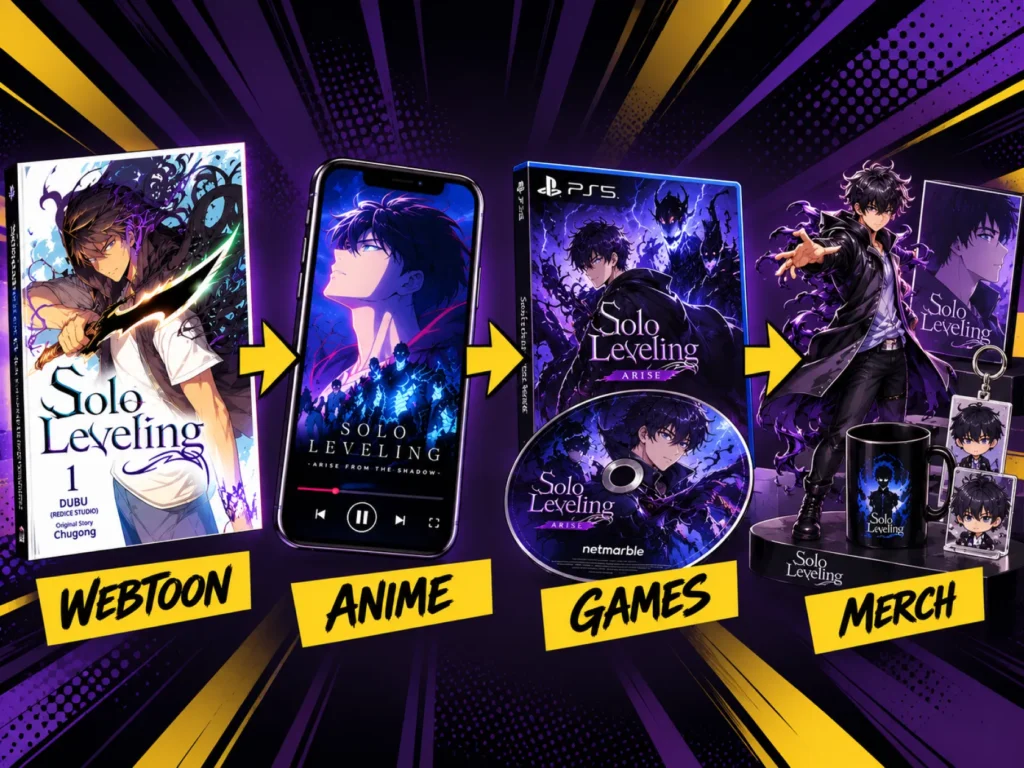
Platforms increasingly treat webtoons as source IP for multi-format expansion rather than as the final product.
Buying Its Way Global
Korea’s global push has been aggressive and platform-led: English-language apps, local original programs, acquisitions, and direct partnerships with streamers. Instead of relying mainly on organic cultural export, the industry has invested heavily in infrastructure, localization, and overseas IP development to scale internationally.
China — The Platform-Plus-State Industry
The Chinese manhua industry is digital, platform-driven, and shaped by a strong regulatory layer.
How Work Gets Published
Most modern manhua is published on major digital platforms such as Kuaikan, Bilibili Comics, and Tencent’s comic services.
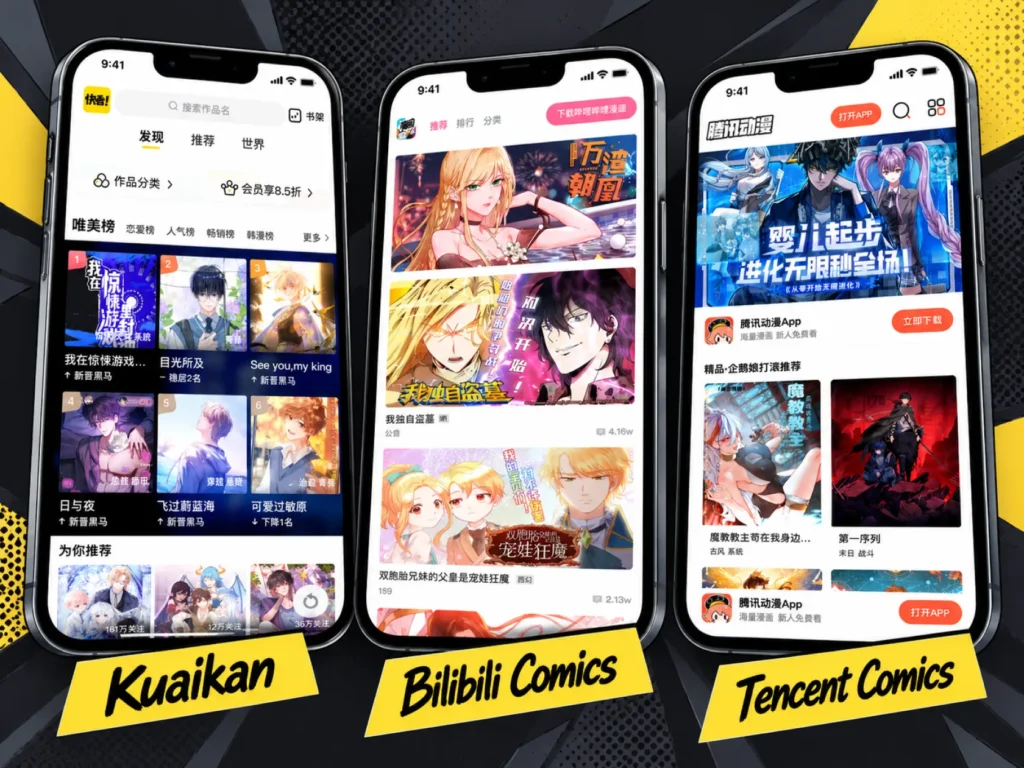
Creators typically work through platform contracts or studio partnerships rather than a traditional magazine system. Discovery and monetization are tightly controlled by the platforms themselves.
The Regulatory Layer
Unlike Japan or Korea, Chinese platforms operate under clear state content rules. Themes, tone, and certain genres are constrained by regulatory requirements. This means platforms do not only chase audience data — they also manage compliance risk. Power sits with platforms and the state.
Huge Domestically, Quiet Abroad
China has a very large domestic comics and web-novel audience, and popular titles can reach massive scale inside the country. International visibility, however, remains more limited compared with Japanese manga or Korean webtoons. Export is growing, but it is not yet the industry’s main growth engine.
What It’s Known For
Chinese manhua is especially associated with cultivation, xianxia, and long-form fantasy series, many of which start as web novels before being adapted into comics. Full-color digital presentation is the norm.
Reliable English-language data on contracts, creator pay, and exact platform economics is thinner than for Japan or Korea, so this section stays deliberately conservative
Side-by-Side: The Three Industries Compared
| Japan | South Korea | China | |
|---|---|---|---|
| Power sits with | Publishers | Platforms | Platforms + state |
| Origin of the model | Print serialization | Digital-native | Digital-native |
| Gatekeeping | Editorial committees | Audience data/algorithms | Regulators + platforms |
| Creator entry | Competitive, deal-based | Open submission | Platform-dependent |
| Editorial control | High | Low to moderate | Moderate + compliance |
| Monetization | Volume sales, digital, licensing | Freemium, fast pass, ads, tips | Freemium, platform subscriptions |
| Who bears the risk | Publisher | Platform | Platform |
| Export engine | Anime adaptation | Streaming/IP pipeline | Limited |
| Known strengths | Deep catalogue, craft discipline | Speed, genre range, mobile UX | Domestic scale, cultivation genres |
Why Korea’s Model Spread So Fast
Why are webtoons more popular than manga in many digital markets?

Not because the stories are inherently better — but because the Korean model removed friction at every step.
Mobile UX Was the Wedge
Vertical scroll was designed for the phone, not adapted from print. Readers didn’t need to learn a new reading habit. The format matched how people already scrolled social media, which made first contact almost effortless.
Pricing Removed the Barrier
Freemium and “wait-or-pay” systems let readers start for free and only pay when they were already hooked. That lowered the cost of trying a new series dramatically compared with buying print volumes or locked digital chapters.
Low Production Risk Enabled Genre Range
Platforms carry low marginal cost per additional series. That made it easier to test niche premises, romance variants, and experimental tones without the same financial pressure that print magazines face. More experiments reached readers.
The Adaptation Flywheel
Once a title proved itself with live audience data, it became ready-made IP for dramas, streaming series, and games. Successful adaptations then drove new readers back to the original webtoon. The comic was no longer the end product — it was the first stage of a larger content machine.
Together, these advantages explain why the Korean model scaled internationally faster than traditional manga publishing structures.
What This Means for Readers
These industry structures show up in your reading experience more than most people realize.
Pacing feels different because weekly digital episodes are designed for short mobile sessions, while collected manga volumes are built for longer sittings. Genre range is wider on open platforms, which is why more niche romance, drama, and experimental titles survive. How you pay also changes: print volumes and subscriptions versus per-episode unlocks, wait timers, and free starter chapters.
It also explains what gets adapted. Korean source material has fed so many recent streaming series because platforms already have live audience data and a built-in IP pipeline.
Finally, how do webtoon creators get paid depends on the channel. Reading on official platforms routes revenue back to the people who made the work — whether the series came from Japan, Korea, or China. That is the simplest practical difference for readers who care about the craft continuing. To learn more about why reading official releases matters, check out our article: Why Reading Official Supports Creators.


Thanks for reading.
Once you see who holds the power in each market, a lot of the differences between manga, manhwa, and manhua suddenly make sense. Hope this helped.
See you soon, Alex