How to Become a Webtoon Artist: Two Routes Into the Job

By Alex Corner
 Nov 5, 2026
 15 min
In today’s article, I want to talk to you about how to become a webtoon artist. I’ve been asked about this quite a few times, and it’s easy to see why!
Creating webtoons is a fascinating career, but it’s also a demanding one that takes a lot of time, effort, and dedication.
But let’s take things in order.
How to become a webtoon artist starts with one decision most guides never name. Every aspiring webtoon creator faces an important choice: work independently as a solo artist, or join a studio? Both paths have their own advantages and drawbacks, and the right choice depends on your skills, goals, and working style.
In this guide, we’ll explore what each option has to offer, how to decide which path suits you best, and, most importantly, where to start if you want to turn your passion for webtoons into a career. If you’re ready to take your first step, you can also Sign up on HoneyToon and explore the platform. So, let’s dive in!
What a Webtoon Artist Actually Does
A webtoon artist career is not one job title. The work splits into two paths that look similar from the outside and feel nothing alike once you are inside them.
The Solo Creator
A solo creator is responsible for the entire webtoon production process. They write the script, sketch the initial concepts, create the storyboard, clean up the line art, color every panel, add dialogue and lettering, and upload the finished episodes to their chosen platforms. In other words, they have full creative control and retain ownership of their webtoon.
However, building a career as a solo creator is usually a slow process. Many artists start by publishing their work on free platforms, where they can gradually build an audience, gain recognition, and develop their own style. This approach gives them the freedom to experiment and grow at their own pace, but it also means that income rarely comes right away. Before a solo creator can start earning consistently, they first need to establish their presence, attract readers, and build a loyal following.
The Studio Artist
If you choose to work for a studio, the process looks quite different. A studio artist is hired to fill a specific role in a larger production pipeline, with each stage handled by a dedicated professional. First, a scriptwriter develops the story. Then, one artist creates the storyboard, another handles the clean line art, someone else takes care of coloring, and another artist works on the backgrounds. There are also translators who help bring the finished webtoon to international audiences. Throughout the entire process, managers oversee the workflow, coordinate the team, and make sure everything stays on schedule.
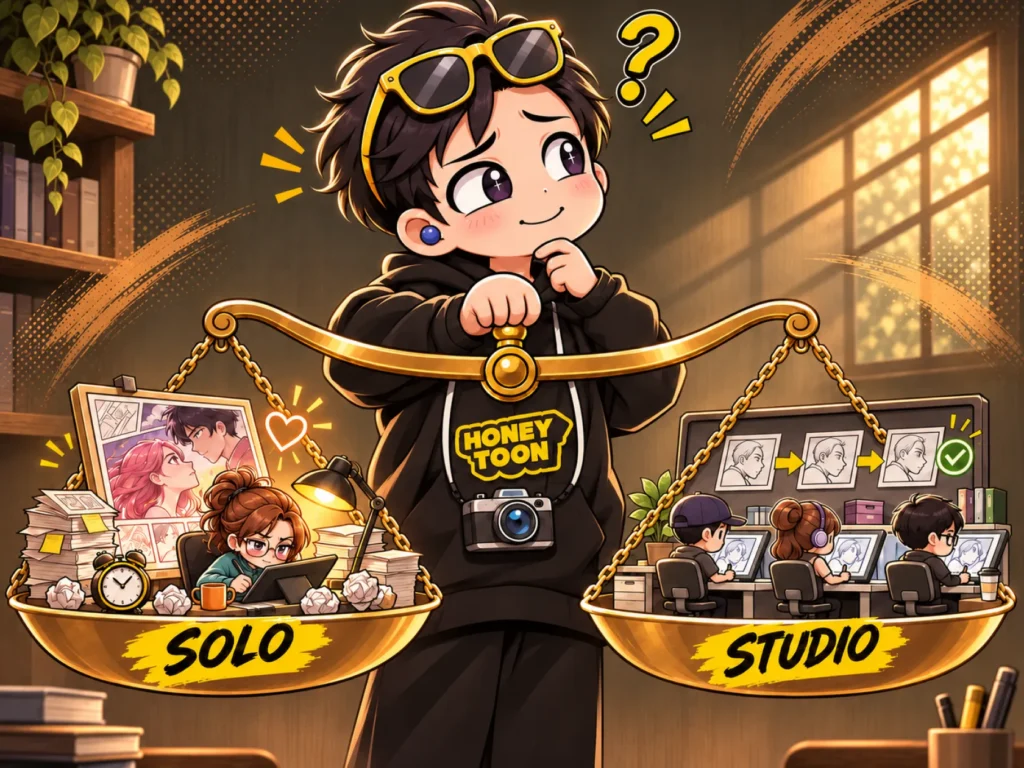
In this setup, the webtoon typically belongs to the studio or the rights holder, rather than to the individual artists working on it. However, there’s one significant advantage: you can start earning from your work almost immediately. Instead of spending months building an audience before seeing any income, you receive payment for the work you do. You also learn to meet strict deadlines, collaborate with other professionals, and follow an established style guide to ensure visual consistency throughout the series.
The trade-off is creative freedom. You might spend your entire career working on other people’s stories without ever writing or illustrating a webtoon of your own. For some artists, that’s a perfectly good arrangement; for others, it’s a reason to pursue a solo career instead.
The Six Roles Behind One Episode
In a studio, producing an episode is like running a relay race. Each team member receives the file, completes their assigned task, and passes it on to the next person. This webtoon production pipeline is what allows most professional webtoon series to meet deadlines and maintain a consistent release schedule.
Understanding webtoon studio jobs and who does what can make all the difference when you’re looking for a job in the industry. Instead of applying for a vague “artist” position, you’ll know which specific role to look for and what skills you need to get started.
Story Writer
The writer owns the outline and the full episode script: plot beats, panel-by-panel action notes, and every line of dialogue. The handoff document is what the storyboard artist works from. A portfolio for this seat shows finished scripts, clear structure, and dialogue that fits speech-bubble space.
Storyboard Artist
The storyboard artist turns the script into rough panel sketches: camera angle, character placement, expression, action flow, and where bubbles will sit. Speed matters more than polish. The vertical scroll is planned here, including the empty space that controls pacing. A portfolio needs full episode boards that read cleanly from top to bottom.
Line Artist
The line artist produces clean digital linework from the approved board. Line weight separates foreground from detail. Character consistency is checked against the art character bible. A portfolio should show clean figures, readable faces, and panels that still work when reduced to phone width.
Colorist
The colorist applies base colour, then shadow, light and effects, using locked character palettes so the cast stays consistent across episodes. Mood shifts through colour are part of the job. For anyone asking how to get hired as a webtoon colorist, a portfolio of fully coloured pages, matching styles, and clean flats-to-finish work is the proof.
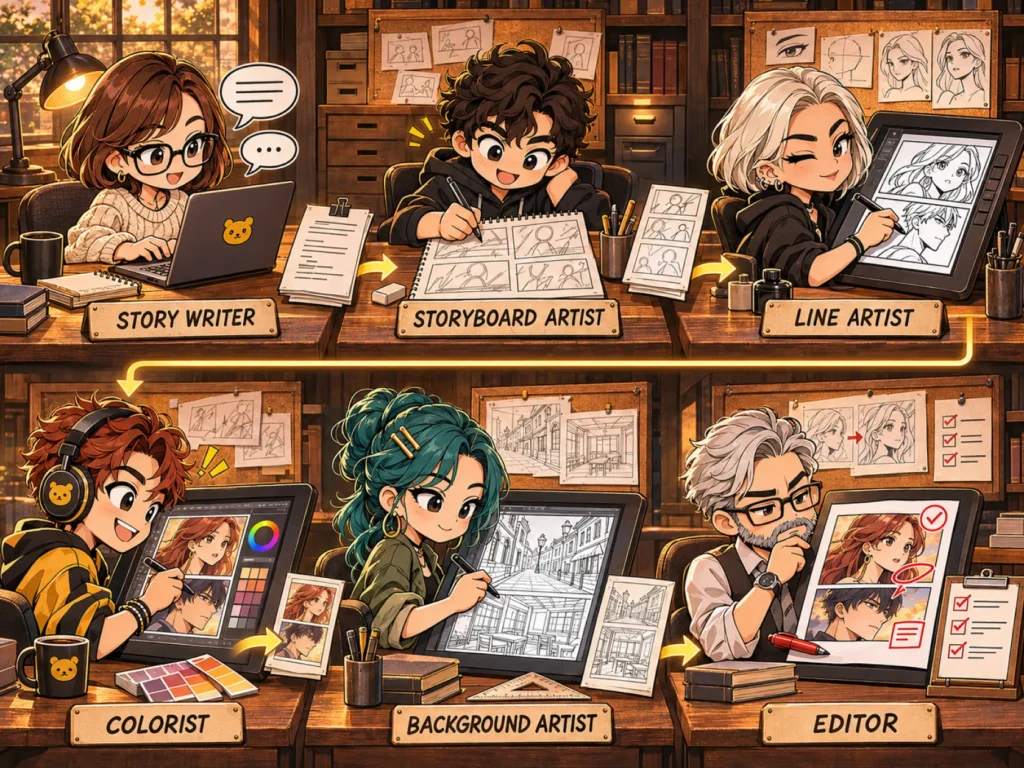
Background Artist
The background artist builds environments and props, often from a style guide for recurring locations. Characters may be drawn by someone else and dropped in later. A portfolio needs interiors, exteriors and depth that hold up under full colour without fighting the figures.
Editor
The editor reviews story and art before the episode goes live: pacing, consistency, production errors, and platform standards. Revisions happen here. This seat is usually platform-side or studio-side rather than a first freelance gig.
For a newcomer, colorist and background artist are hired most often and are the most realistic entry points. They are teachable, constantly in demand, and less dependent on having a signature style of your own.
For a full walkthrough of the same pipeline on the platform side, see How HoneyToon Webtoons Are Made: From Script to Published Episode.
Route One: Publishing Your Own Series
This is the path for people who want to own the work. How to make a webtoon on your own means carrying every stage yourself until a platform or a reader base pays you back.
How the Free-Platform Ladder Works
Platforms like WEBTOON, Tapas, GlobalComix and atc. offer opportunities for creators to publish their work, often without needing to sign a contract beforehand. These platforms have open or semi-open publishing systems that allow new series to reach readers and build an audience. Editorial teams keep an eye on projects that gain traction and attract readers. Once a series starts showing promise, creators may receive offers for paid partnerships, official publication, or a spot in a curated collection. In other words, you publish your work, maintain a consistent release schedule, and let reader engagement help determine whether your project catches the platform’s attention.
One important thing to remember is that publishing your work on a platform doesn’t automatically mean giving up your copyright. Ownership generally remains with you unless you sign an agreement that states otherwise, so always read the terms carefully before accepting a publishing deal.
What You Need Before You Post Episode One
Before the first public episode, you need a finished script for the opening arc, a locked character design sheet from multiple angles, a colour palette you can repeat without drift, and a real buffer. A buffer of at least eight finished episodes before you post episode one is the practical minimum that lets you survive a bad month without breaking the release rhythm. If the buffer is thin, the schedule breaks, and broken schedules kill series on free platforms.
How Long It Realistically Takes
How long does it take to make a webtoon episode as a solo creator is the question that decides whether this route is viable. A full-colour episode of sixty to eighty panels is a working week for one person, not a working day. Script, board, line art, colour, lettering and export all sit on the same calendar. With a full-time job outside the studio, that week stretches into two or three. Route one rewards patience and ownership.
Route Two: Getting Hired by a Studio
The second path is to get hired by a webtoon studio. In this case, you’re no longer the owner of the creative project you’re working on. The story and art direction belong to someone else, and your role is to contribute to the production process as part of a larger team and you receive regular payment for your work.
What a Studio Portfolio Must Show
A studio is not buying your imagination, but your consistency. A strong webtoon artist portfolio for hire proves you can draw the same character a couple of times, from different angles, and still have it look like the same person. Show turnarounds, expression sheets, and several finished panels in one locked style.
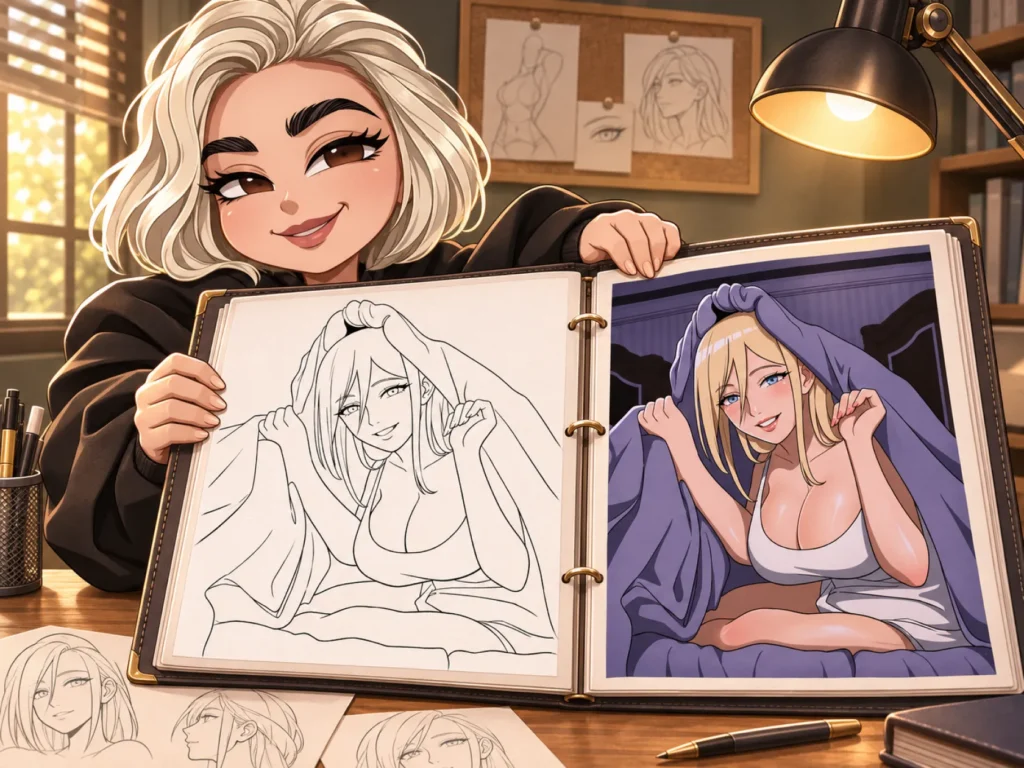
Style experiments belong in a separate personal folder. Recruiters scan for match-the-bible skill, clean files, and the ability to hit a deadline without inventing a new look mid-episode.
The Roles That Hire Most Often
Among webtoon studio jobs, colorist and background artist open the door most often. Both are teachable, both stay in demand on every full-colour series, and neither requires a famous personal style. In practice they function as paid apprenticeships. Many lead artists started in one of those two seats, learned the pipeline from the inside, and moved up once they could prove speed and reliability.
What to Check Before You Sign
Before signing any contract, you need to check four key points. Who owns the art you produce? Whether the rate is per episode or per panel? How revisions are counted and whether extra passes are paid? And finally, fourth — what happens to the work if the series is cancelled.
At the same time, if any of these points in the contract are unclear to you, turn to professional lawyers before you sign any document.
Vertical Scroll Is a Craft, Not a Shape
In a printed comic, the page turn is the timing tool. A vertical scroll comic format has no pages, so the empty space between panels does that job instead.
When we see the short gap – it reads fast. A long gap is a pause. A very long gap is a held breath before a reveal. That’s exactly why white space is an active tool for a webtoon artist. Without white space, a webtoon feels flat, so the artist who controls the gaps controls the tempo and rhythm of the comic. When studios hire, they immediately pay attention to how the artist builds the comic’s rhythm.
It’s best to follow this rule: one beat per screen. The reader’s phone is the panel border. Anything the reader has to scroll to complete is split across two moments, whether you intended it or not.
Webtoon Canvas Size and File Specs
The figures below are the standard working targets for webtoon canvas size and export. Confirm them on the platform’s own help pages before your first upload, because specs can move.
Technical specs
| Spec | Value |
|---|---|
| Upload slice size | 800 x 1280 px per image |
| Recommended working width | 1600 px, scaled down on export |
| File format | JPG preferred over PNG, smaller file size |
| Maximum file size | 20 MB |
| Working resolution | 300 DPI, up to 600 if print is ever planned |
Artists draw at 1600 px wide and scale down for upload so line quality survives the export. Detail holds when you shrink a clean file. It does not hold when you draw small and try to enlarge it later. Platform specs change, so check the current numbers on the platform’s own help pages before your first upload.
What Software Webtoon Artists Use
What software do webtoon artists use depends less on brand and more on stage of the career.
The industry standard for professional webtoon and manhwa production is Clip Studio Paint. It includes panel tools, webtoon canvas presets, and lettering utilities built for vertical episodes. Many studio pipelines assume it.
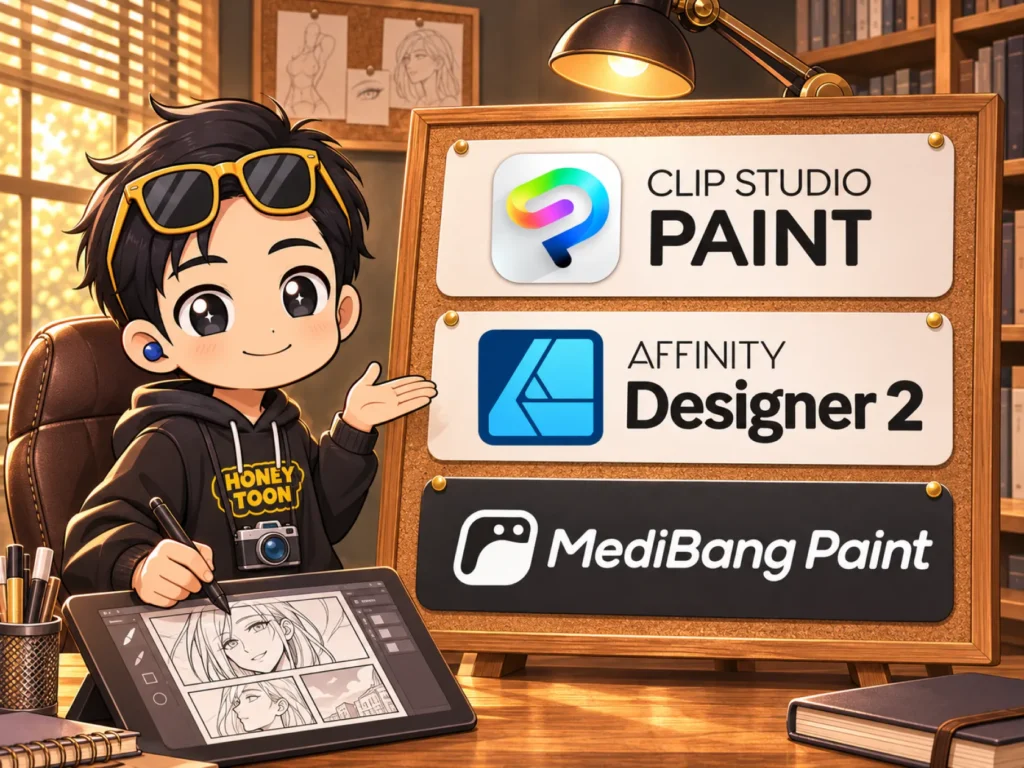
The affordable one-time purchase option is Affinity Designer for artists who want a full digital suite without a subscription. The program handles high-resolution pages and exports cleanly, but does not mirror every webtoon-specific preset.
The free option that is genuinely good enough to start with is Medibang Paint for lighter comic layouts. It supports layers, brushes and high-resolution canvases. Either is enough to build a first portfolio and learn the pipeline.
None of these tools is mandatory, but be prepared that any studio will expect you to switch to the software they use.
What Webtoon Artists Earn
And, of course, one of the most important questions to consider is webtoon artist salary. According to WEBTOON’s June 2024 SEC filing, professional creators earned an average of about $48,000 a year, the top 100 averaged around $1 million, and the platform paid out roughly $2.8 billion to creators between 2017 and 2023.
And these figures specifically refer to “professional authors” who are already working under contract. So this number does not take into account the large portion of creators who publish on free platforms and earn nothing at all. How much do webtoon artists make depends first on whether they have crossed into paid work at all.
Every choice comes with its own risks. Working in a studio guarantees stable, though modest, pay starting from the very first week. Self-publishing brings no income for a long time, but if the project becomes successful, the earnings can grow rapidly.
Neither option is safer: in one case you sacrifice ownership rights for the sake of predictability, in the other you sacrifice predictability for the sake of ownership.
The Mature Webtoon Lane
Career guides almost never name this lane, yet it is a real hiring path for a manhwa artist. Mature and 18+ webtoon studios run the same six-seat pipeline as any other studio. They hire on the same portfolio standards and ship on regular schedules. For someone starting out, that means steady paid work and a fast learning curve, because episode volume is high and the production line does not pause.
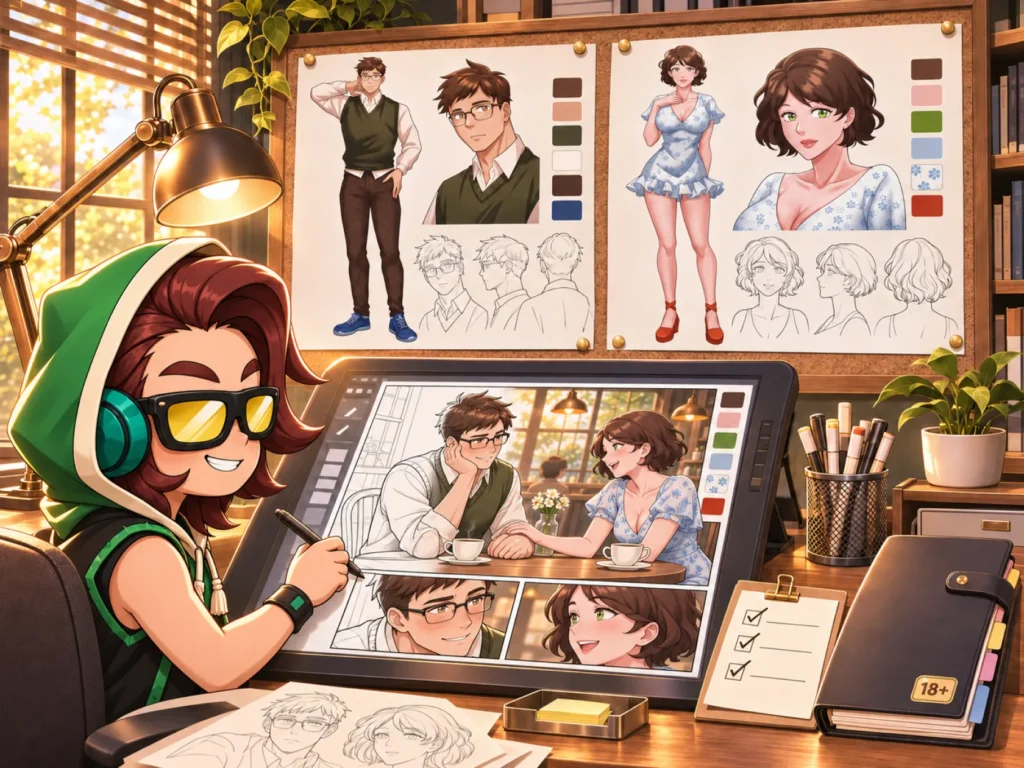
Two points are worth noting. First, some artists publish such works under a pen name, which is a completely normal practice in this field. And second, the skill requirements here are no lower — in fact, they are often even higher — because anatomy, framing, and pacing are critically important for the reader.
If your portfolio already shows clean figure work, locked character sheets and reliable colour, this lane evaluates the same skills as the mainstream one.
Seven Mistakes That Stall New Webtoon Artists
- Posting episode one with no buffer behind it
Without at least several finished episodes in reserve, one bad week can break the schedule and readers will leave. - Designing a main character you cannot draw quickly from three angles
If every turn takes hours, you won’t be able to keep up with a weekly or bi-weekly release schedule. - Treating the vertical scroll as a tall page instead of a timeline
A fully drawn long series without empty space reads flat. Tempo and rhythm are among the most important things studios look at. - Building a portfolio of single showpieces instead of repeatable, consistent work
Hiring managers need proof you can draw the same face twice, not one perfect illustration. - Waiting to be discovered instead of applying for studio seats
Colorist and background roles hire on open applications and it’s better than nothing. - Choosing a colour palette that takes too long to reproduce every episode
A beautiful scheme you cannot repeat under deadline becomes a production tax every week. - Quitting the day job before the first contract, rather than after it
Unpaid months are normal on the solo path. Cut income only when paid work is already in hand.
Your First 90 Days: A Starting Plan
To help you start a career as a webtoon creator, we’ve outlined three stages of planning so that you can begin your journey as early as tomorrow.
Days 1 to 30. Fundamentals and a locked character sheet. Draw one main character from front, side and three-quarter views until the face stays the same. Write a short art bible: proportions, hair, signature clothes, a couple of expressions. Pick a simple colour palette you can repeat. Set your canvas to 1600 px working width. At this stage, you shouldn’t publish anything.
Days 31 to 60. Produce one full episode at real specs: script, storyboard, clean line art, colour, lettering, export to 800 x 1280 slices under 20 MB. At this stage, you need to analyze what took you the longest to create and where your time was spent.
Days 61 to 90. Choose the route. Solo path: finish three more episodes so you hold a four-episode buffer before anything goes live. Studio path: build a short, consistent portfolio aimed at colorist or background seats, then apply. Either way, the ninety days end with finished files, not plans.


So from the bottom of my heart, I wish you good luck with your choice and with your further growth.
And we’ll see each other in the next article.
This was Alex Corner.